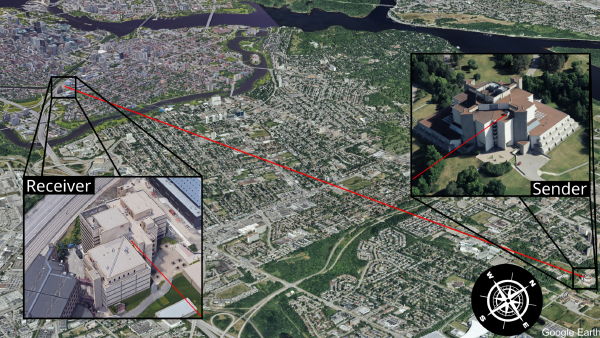
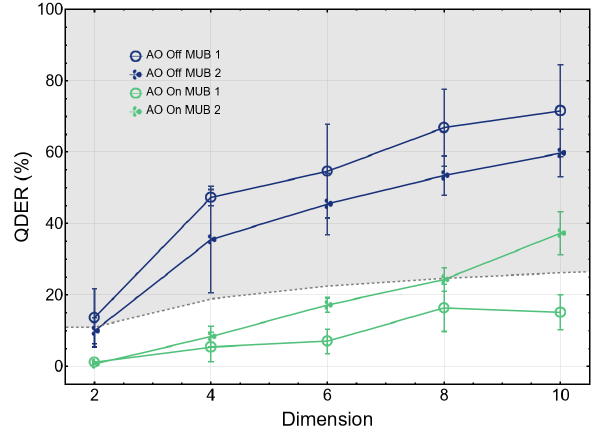
In this work, we showed that the use of a fast adaptive optics system in a high-dimensional quantum key distribution setup allows for secure communications even in the presence of significant noise.
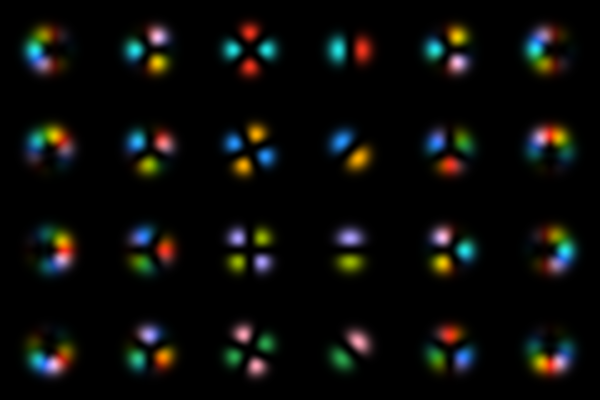
We introduce a high-dimensional QKD protocol using qubit-like states that are superpositions of only two computational basis states. This simplifies experimental implementation while providing a measured sifted key rate above 1 bit per photon in a noisy 4-dimensional channel.
We present a machine learning approach to forecast atmospheric turbulence (Cₙ²) up to 12 hours in advance. By predicting channel conditions, we can determine optimal timing for secure key exchange in free-space quantum networks.
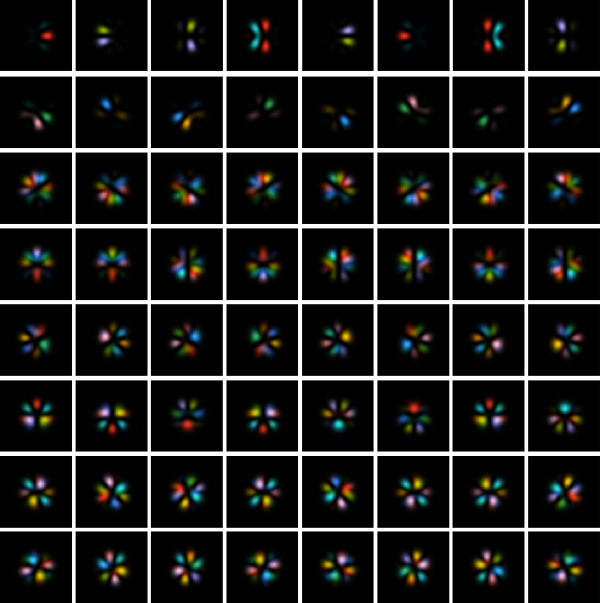
We employ a high-speed Adaptive Optics (AO) system to correct real-time wavefront distortions in spatial modes, significantly reducing crosstalk and error rates for OAM-based QKD in turbulent environments.